Why the Classic Plunge Dipping Remains a Powerful Tool Against Ectoparasites
Plunge dipping remains a powerful tick-control method because of its thorough body coverage. Understand where pour-ons can fall short and why correct application, product choice and monitoring matter in protecting livestock from ectoparasites.
Pour-ons have made tick treatment easier for many livestock farmers. They require relatively little equipment and can be applied quickly. However, ease of application does not necessarily mean the most thorough treatment.
Where suitable facilities are available, plunge dipping remains one of the most effective methods of applying contact tick-control products across an animal’s body. Its major strength is coverage: bringing the treatment into contact with areas that can be missed during incomplete spraying or inadequately distributed topical treatment. FAO recognises dipping vats as a highly effective method of applying acaricides the chemicals used to kill ticks.
That advantage matters because ticks often attach in places farmers do not immediately see.
Ticks do not only attach where treatment is easiest to apply
The South African bont tick, Amblyomma hebraeum, transmits the organism responsible for heartwater. It favours protected attachment sites, including areas beneath the animal and, particularly in sheep and goats, between the claws.
South African research on goats highlights how infestations around the feet can cause wounds, secondary infections and lameness. The researchers also emphasise the value of directing treatment towards preferred attachment sites.
For farmers, this means that an animal looking clean along its back is not enough. The feet, belly, armpits, udder or scrotum, and area beneath the tail deserve attention during inspection.
The main advantage of plunge dipping is thorough wetting
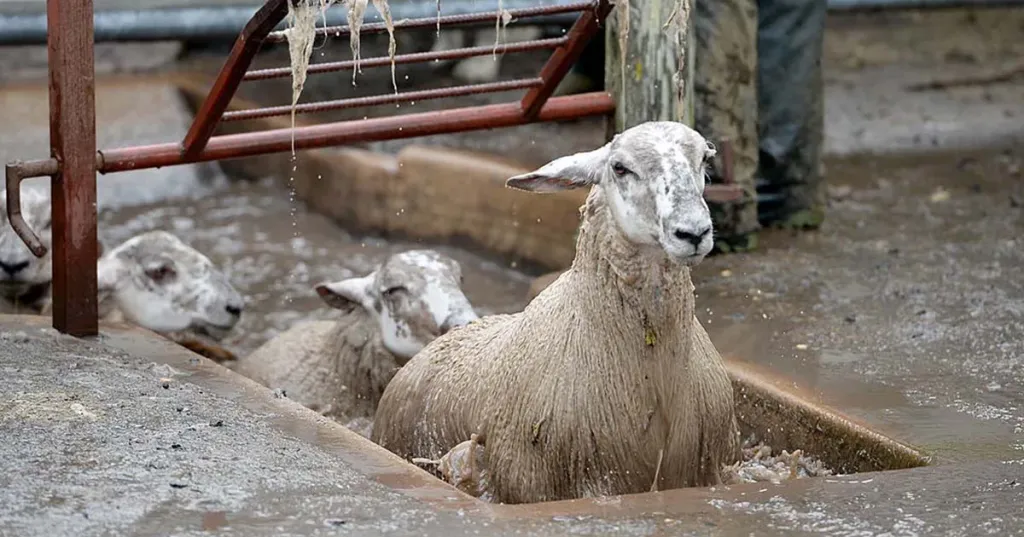
During properly performed plunge dipping, the animal passes through a correctly prepared treatment solution. This provides broad contact with the body, reducing reliance on a small volume of product spreading from a limited application area.
This is a strong practical reason to retain plunge dipping in tick-control programmes, particularly where thorough coverage is difficult to achieve by other methods.
However, immersion must not be mistaken for guaranteed contact with every tick. Sheltered areas can still escape effective treatment, and animals should be inspected afterwards. Proper facilities and trained handling are essential; improvised submersion can cause injury or drowning.
Why pour-ons remain useful and where their limitations matter
Pour-ons are legitimate tick-control tools. Their formulations are designed to distribute the active ingredient over the skin and coat; some products also act systemically. They do not need to visibly soak every body part to work.
There is local evidence of their usefulness. A University of Pretoria study in Makhuduthamaga, Limpopo, reported a 94.5% reduction in tick numbers in indigenous goats receiving a deltamethrin pour-on programme compared with untreated controls.
However, ticks were reinfesting treated goats towards the end of the three-week application interval. The study demonstrated useful control, not complete protection, and did not compare the programme directly with plunge dipping.
Distribution can also be affected by the animal’s coat. In a South African cattle trial, an amitraz spray dip gave better initial and persistent control of bont ticks than the tested amitraz/cypermethrin pour-on. Researchers suggested that the cattle’s rough winter coats had hindered the pour-on’s spread.
Although this was a comparison of specific products in cattle, rather than plunge dipping in goats, it illustrates why thorough wetting can offer an advantage when topical distribution is inadequate.
Farmers should therefore judge a pour-on by its approved tick claims and the results achieved throughout the treatment interval, not simply by how easy it is to apply.
A spray race can work well, provided it actually wets the animal
Spray races offer another way of applying contact treatments over the body. Their success depends on functioning nozzles, suitable pressure, correct operation and adequate wetting.
An animal walking through a cloud of spray is not necessarily thoroughly treated. Veterinary guidance identifies incomplete wetting, especially around the ears and beneath the tail, as a limitation of spray races.
The same principle applies to hand spraying: reaching the animal is not enough if the treatment fails to reach the tick attachment sites.
Even a plunge dip fails when the chemical programme is wrong
Coverage is only one part of effective control. The product must be suitable for the livestock species, approved application method and target tick. It must also remain effective against the local tick population.
Incorrect dilution, inadequate replenishment and poor dip management can undermine results. In a 2024 Eastern Cape study, farmers using communal plunge dips reported substantial control failure and concerns about solution strength, infrastructure and treatment practices. These reports show that access to a dip tank alone does not ensure effective control.
Follow the product’s instructions for initial filling, mixing, replenishment and disposal. If ticks survive treatment, investigate application quality and possible resistance with an animal-health professional. Increasing the concentration or combining chemicals without guidance is not a sound correction.
Choose the product for the tick you actually have
“Controls ticks” should never replace reading the detailed label.
For example, the bont tick that transmits heartwater is different from the bont-legged tick. A product claim against bont-legged ticks does not automatically establish effectiveness against the heartwater vector. The label must also cover the livestock species being treated.
Similarly, injectable products control some tick species but should not be assumed to provide comprehensive protection against all ticks. Agricultural Research Council specifically noted this limitation in some of their publications.
Control on the animal is not eradication from the farm
Dipping treats the animals passing through the tank. It does not directly eliminate every tick developing or waiting in the surrounding environment.
Camp resting can help interrupt tick life cycles, but its success depends on the tick species, climate, length of rest and presence of other hosts. A short grazing rotation cannot be assumed to remove the challenge. Sustainable control combines appropriate treatment with monitoring, grazing management where practical, and measures to limit resistance.
For heartwater-prone farms, reduced tick counts should not be mistaken for guaranteed disease prevention. Infected ticks can remain a threat, including small nymphs that are easily overlooked.
Plunge dipping deserves its continued place in livestock management because thorough coverage is a valuable advantage. Pour-ons remain useful, but farmers should check that their chosen program controls ticks at the difficult attachment sites and continues working between treatments. The practical test is what happens on the animal after treatment, not simply which method was used.
Explore Topics
Written by
Setlago Rehlotse
Content creator and writer sharing insights and stories.